
Glass Walls in Costa Rica: The Comfort Strategy Nobody Talks About
The ocean view is why you bought the lot. The glass wall is how you capture it. What happens next is where most builders stop thinking.
Large glass walls are the defining move of modern coastal construction in Costa Rica. Floor-to-ceiling openings that bring the ocean into the living room. The renderings always look incredible. The experience after move-in is where the story diverges.
Some homes are comfortable year-round. You walk in, the space feels open and alive, the view is everywhere, and the house works. Others look identical from the outside but become difficult to use by mid-afternoon. The air conditioning runs constantly. Certain rooms are avoided during peak sun hours. The power bill arrives and something feels wrong.
The difference is not the glass itself. It is the strategy behind the glass. And most builders in this market do not have one.
TL;DR
A glass wall home on the Pacific coast of Costa Rica needs a four-layer thermal strategy: overhang geometry, high-performance glazing, insulation, and mechanical cooling. Most homes have one or none of these layers.
- At 10°N latitude, west-facing glass gets direct sun every afternoon from roughly 1 PM until sunset, year-round.
- A deep overhang handles noon to 3 PM. High-performance glass handles 3 PM to sunset. Neither works alone.
- The glazing spec that matters is SHGC (Solar Heat Gain Coefficient). Most owners have never heard this number. Most builders cannot tell you theirs.
- Spray foam insulation keeps the entire envelope from radiating heat into the living space. Almost nobody in Costa Rica is doing it.
- Central air ties the system together. Mini-splits cool individual rooms. Central air manages the whole home as one thermal zone.
This guide explains how each layer works, why skipping any one of them creates the problems you hear about from other homeowners, and what to ask a builder so you can tell immediately whether they have a real thermal strategy or are just selling glass.
The 60-second decision frame
You are not deciding between more glass and less glass. You are deciding between glass with a thermal strategy and glass without one.
A home with large glass walls and a real thermal strategy is more comfortable than a home with small windows and no strategy. The glass is not the problem. The absence of a plan for the glass is the problem.
If your builder shows you a rendering with a full glass wall facing the ocean and cannot explain the shading geometry, the glazing specification, the insulation plan, and the cooling system in specific terms, they are selling a rendering, not a livable home.
If you only read two sections:
Then decide whether you want the deeper detail on each layer.
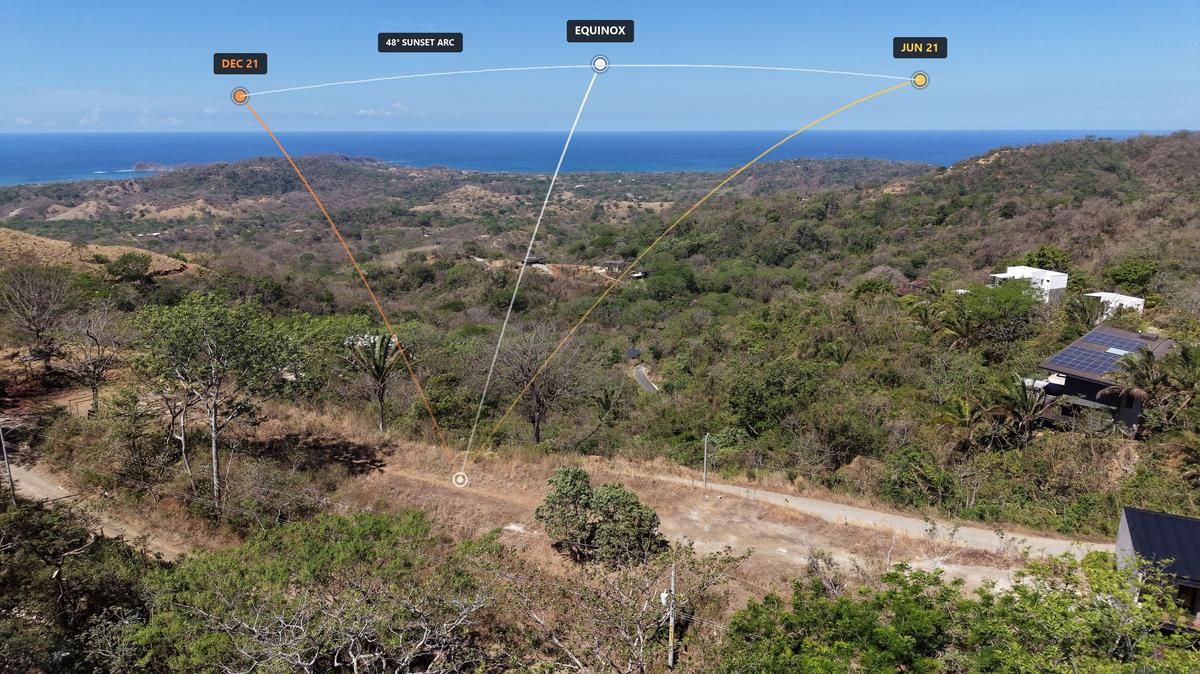
The sunset sweeps a 44° arc across the Pacific horizon. December far left, June far right. Every afternoon, that sun is aimed directly at your glass wall.
Why most glass wall homes on the coast are miserable by 3 PM
Costa Rica sits between 8° and 11° north of the equator. The sun does not behave here the way it does in the continental United States.
In the US, the sun is always somewhat to the south. A west-facing window gets afternoon sun, but it is angled, seasonal, and manageable. In Costa Rica, the sun passes nearly directly overhead at midday and then drops toward the western horizon on a steep, direct path. The afternoon sun is not a side-angle nuisance. It is a full-frontal assault on any west-facing surface.
If your lot has an ocean view, your glass wall almost certainly faces west or southwest. That is the view. That is also where the sun sets. Every day. All year.
What actually happens inside a glass wall home with no thermal strategy
Here is the timeline on a clear February afternoon in Nosara, Guanacaste. This is the design case for thermal performance. No clouds, peak dry season, sun tracking nearly due west:
| Time | What is happening |
|---|---|
| 12–1 PM | Sun is high overhead. Little direct sun on the west-facing glass. The house feels fine. |
| 1–2 PM | Sun drops to roughly 55–70° altitude. If you have an overhang of 2.5 meters or more, the glass is still fully shaded. If your overhang is decorative (under 1.5 meters) or nonexistent, sun is already hitting the upper portion of the glass wall. |
| 2–3 PM | Sun drops to roughly 40–55°. A 3-meter overhang keeps about 80% of the glass shaded. A 1-meter overhang shades less than 30%. Homes without a real overhang are fully exposed. |
| 3–4 PM | Sun drops below 40°. Even a 3-meter overhang only shades about half the glass. The glass specification now matters more than the overhang. Homes with standard single-pane or low-performance double-pane glass are radiating heat into the living room. The AC is struggling or the room is being abandoned. |
| 4–5 PM | Sun is below 25°. No practical horizontal overhang works anymore. The glass alone is the thermal barrier. Homes with high-performance glass feel warm but manageable. Homes with standard glass feel like a greenhouse. |
| 5–6 PM | Sunset. The direct load drops. But the interior surfaces (floors, walls, furniture) have been absorbing heat for hours. They radiate it back into the room. Homes without insulation on the roof and exterior walls continue feeling hot well into the evening. |
This timeline repeats every clear afternoon from roughly November through May. That is more than half the year. During the rainy season (June through October), afternoon clouds reduce the load most days, but the mornings are still clear and hot, and the cloud cover is not something you can design around.
Most glass wall homes in Nosara were designed for the rendering, not for 3 PM in February. That is not a builder quality problem in every case. It is a design priority problem. The rendering showed a beautiful house. Nobody modeled what happens when the sun hits that glass wall for five straight hours with no shade and no thermal defense.
The neighbor test
Next time you drive through a coastal development in Nosara or Guanacaste, look at the homes with large glass walls facing the ocean. Count how many have deep covered decks on the back. Count how many have no overhang at all. Just glass straight to a thin roof edge.
Then ask any homeowner you meet: “Where do you hang out at 3 PM?”
The answer will tell you everything about whether the thermal strategy is working.
The four-layer thermal strategy
A livable glass wall home in this climate is not one product decision. It is four layers working together. Skip any one of them and the others have to compensate. That means higher energy costs, lower comfort, or both.
Layer 1: Overhang geometry. The first line of defense
A horizontal overhang is the most effective, lowest-cost thermal tool available to a designer in the tropics. It does two jobs at once: it shades the glass wall from direct sun, and it creates covered outdoor living space underneath.
The physics are simple. The sun is high in the early afternoon and low in the late afternoon. A horizontal overhang casts a shadow straight down. The deeper the overhang, the later in the day the glass stays shaded.
| Overhang depth | Glass shaded at 2 PM | Glass shaded at 3 PM | Glass shaded at 4 PM |
|---|---|---|---|
| 1.0 m (~3 ft) | 44% | 27% | 15% |
| 1.5 m (~5 ft) | 66% | 40% | 23% |
| 2.5 m (~8 ft) | 100% | 67% | 38% |
| 3.0 m (~10 ft) | 100% | 81% | 46% |
| 4.0 m (~13 ft) | 100% | 100% | 61% |
Calculated for 10°N latitude, equinox (March/September), due-west wall orientation, 10 ft glass height, overhang at glass-top. These are the worst-case clear-sky months.
1.5m Overhang (~5 ft)
3.0m Overhang (~10 ft)
4.0m Overhang (~13 ft)
Shaded Exposed Equinox, 3 PM, 10 ft glass wall facing west
A 3-meter overhang keeps your glass fully shaded until 2 PM and 81% shaded at 3 PM during the critical February-through-April window. A 1-meter overhang, common in decorative modern designs, barely covers a quarter of the glass by 3 PM.
The cost argument: Covered deck space is dramatically cheaper per square foot than enclosed, conditioned interior space. A 3-meter covered deck costs a fraction of an equivalent interior room but delivers something no interior room can: outdoor living space that is usable in rain and shade. It is the highest-value square footage in the house.
No overhang works after 4 PM. The sun angle drops below 25° and no practical horizontal structure can shade the glass. That is where the next layer takes over.
Layer 2: Glazing performance. What the glass actually does
All glass is not the same. The difference between standard glass and high-performance glass is not visible to the eye. You cannot tell by looking. You can tell by standing inside.
The number that matters is called SHGC, or Solar Heat Gain Coefficient. It measures how much solar energy passes through the glass as heat, on a scale from 0 to 1. Lower is better. A standard single-pane window has an SHGC around 0.86. That means 86% of the sun's heat passes straight through. It is essentially a hole in the wall with a piece of glass pretending to be a thermal barrier.
| Glass type | Typical SHGC | Heat blocked |
|---|---|---|
| Standard single pane | 0.86 | 14% |
| Standard double pane | 0.65–0.76 | 24–35% |
| “Energy efficient” residential | 0.35–0.45 | 55–65% |
| Commercial office tower (Miami, Dubai) | 0.25–0.35 | 65–75% |
| High-performance commercial (LEED Platinum) | 0.20–0.28 | 72–80% |
The glass used in most residential construction in Costa Rica falls somewhere between standard double pane and basic energy-efficient, with an SHGC around 0.45 to 0.65. That means 45 to 65 percent of the sun's heat is getting through. On a 10-foot floor-to-ceiling glass wall facing due west at 3 PM in February, that is an enormous amount of thermal energy entering the room.
Price does not predict thermal performance. Some of the most expensive homes on the coast use the same standard glass as the most modest ones. The cost went into finishes, not assemblies. A million-dollar home with beautiful tile and standard glass will be less comfortable at 3 PM than a home at half the price with high-performance glazing and deep overhangs.
Commercial office towers in Miami and Dubai use glass in the 0.25–0.35 SHGC range. Those buildings are 100% glass with zero overhangs. They compensate with massive HVAC systems and accept the energy cost. Their glass specification is the only thermal barrier between the sun and the interior.
The technology is not exotic. Double-pane glass with a low-emissivity (Low-E) coating and argon gas fill between the panes achieves SHGC values of 0.27 to 0.30. That blocks 70 to 73 percent of solar heat. The coating is spectrally selective, which means it treats visible light and infrared heat differently. Visible light passes through so the room stays bright and the view stays clear. Infrared energy, which is what creates the heat, gets reflected. The result is a glass wall that lets you see the ocean but blocks most of the energy that would turn your living room into a greenhouse. Add a PVC thermal break in the frame to prevent heat conduction through the aluminum, and you have a glazing system that performs at commercial tower level.
The question is not whether this technology exists. It does. The question is whether your builder is using it, and whether they can tell you the SHGC of their glass. Most cannot.
The one question that reveals a builder’s glass strategy
“What is the SHGC of the glass you use on west-facing walls?”
If the answer is a specific number below 0.35, they are thinking about this. If the answer is vague (“we use high-quality glass” or “it’s double-pane”), they have not specified for thermal performance. Double-pane is a construction category, not a performance specification. There are double-pane windows with an SHGC of 0.65 and double-pane windows with an SHGC of 0.27. The difference in lived experience is enormous.
Layer 3: Insulation. The invisible multiplier
Glass is not the only surface absorbing heat. The roof takes the worst of it. Direct overhead sun for 8 to 10 hours a day. Exterior walls absorb reflected and radiated heat from all directions. Without insulation, those surfaces become heat emitters after sundown. The house cools slowly. The AC runs all evening. Energy costs climb.
In the United States, insulation is code-mandated and universal. In Costa Rica, it is rare. Most homes have no insulation in the roof, the walls, or anywhere else. The building code does not require it, local builders are not trained in it, and the materials are not stocked at local suppliers.
Closed-cell spray foam insulation is the standard in US commercial and residential construction. It seals the building envelope completely. No gaps, no thermal bridges, no convective air leaks. It adheres directly to the underside of the roof deck and the interior face of exterior walls. The result is a continuous thermal barrier that dramatically reduces heat transfer into the living space.
The practical impact: a home with spray foam insulation and high-performance glass reaches a comfortable temperature faster, holds it longer, and runs the AC less aggressively than a home without insulation. The difference is measurable in the power bill and obvious in lived comfort, especially in the evening hours when an uninsulated home continues radiating absorbed heat long after the sun has set.
At electricity rates three times higher than most of the US, the insulation pays for itself. But the real value is not the payback calculation. It is the comfort delta. The home simply feels different.
Layer 4: Mechanical cooling. The final backstop
Even with deep overhangs, high-performance glass, and full insulation, a tropical home needs mechanical cooling. The ambient temperature and humidity in Guanacaste are high enough that passive strategies alone cannot maintain comfort at all hours.
The question is what kind of mechanical cooling and how hard it has to work.
Most homes in Costa Rica use mini-split units. Individual wall-mounted air conditioners, one per room. They are inexpensive to install, widely available, and adequate for individual rooms. Their limitation is that they cool zones, not the house. Walk from a cooled bedroom into an uncooled hallway and you feel the transition immediately. Open the bedroom door and the unit fights the entire house’s heat load through that opening.
Whole-home cooling is what ties the thermal strategy together. In some homes that means central air. In others it can mean a well-zoned mini-split plan. The important question is not the equipment label. It is whether the cooling system is designed for the house as a full envelope rather than left to fight room by room.
Central air is still uncommon in Costa Rica. The equipment is imported, the ductwork requires coordination during the structural phase, and the installation expertise is specialized. That is one reason many builders default to mini-splits. Mini-splits are not wrong. They just become a weak answer when the glass, overhangs, and insulation have not been solved first.
The distinction matters because the cooling system should be the final backstop, not the first line of defense. In a home designed around the four-layer strategy, the cooling system is handling the residual load. In a home with no other layers, the cooling system is carrying the full solar load alone. That is where comfort falls apart and operating cost climbs.
How the layers work together
No single layer is the answer. The power of this approach is that each layer reduces the load for the next:
| Layer | What it handles | What it cannot do |
|---|---|---|
| Deep overhang | Blocks 80–100% of direct sun until 3 PM | Cannot shade against low-angle sun after 4 PM |
| High-performance glass | Blocks 70–73% of solar heat that reaches the glass | Cannot block 100%. Some heat always transmits |
| Spray foam insulation | Prevents roof and walls from radiating absorbed heat inward | Does not help with direct solar gain through glass |
| Central air | Removes residual heat and controls humidity | Expensive and energy-intensive if it is the only defense |
A home with all four layers keeps the living room comfortable at 3 PM in February with the AC running at normal effort. A home with only the last layer, which is what most glass wall homes in Nosara have, is fighting the full solar load with brute-force cooling. That works, technically. But the AC runs constantly, the power bill is painful, and the moment the power flickers (which happens regularly in rural Costa Rica), the house becomes unlivable within minutes.
Why the stack matters
A high-performance glazing spec is powerful. It is not magic. If the house has no overhangs, no insulation, and no coherent cooling plan, the glass is being asked to solve a problem it cannot solve alone.
The better way to think about it is load reduction in sequence. Overhangs block the early sun. Glass reduces the solar gain that still reaches the wall. Insulation prevents the rest of the envelope from storing and re-radiating heat. The cooling system handles what remains.
That is why the same glazing package can feel impressive in one house and disappointing in another. Performance is not one product. It is the stack.
What to ask any builder before you commit
You do not need to become a glazing engineer. You need four questions that separate builders who have a thermal strategy from builders who are selling a rendering.
- “What is the SHGC of the glass you specify on west-facing walls?”
A real answer is a number below 0.35. “High quality” or “double pane” is not an answer. - “How deep are the overhangs on the ocean side, and how did you decide that depth?”
If the answer references sun angle, latitude, and shading calculations, they thought about it. If the answer is “it looks right,” they did not. - “What insulation are you using in the roof and exterior walls?”
If the answer is “none” or “it’s not necessary here,” that is a builder who has not felt the difference. Insulation is not optional in a home designed for comfort in this climate. - “How is the cooling system meant to work with the other three layers?”
Ask whether the home is relying on mini-splits to fight the entire solar load room by room, or whether the cooling system was designed as the final backstop after shading, glazing, and insulation were solved.
Any builder who can answer all four questions with specifics is thinking about your comfort. A builder who struggles with any of them is focused on something else. Neither answer is necessarily disqualifying. But it tells you how much of the thermal engineering you will need to drive yourself.
The short answer: a glass wall home in the tropics is not a risk. It is a commitment. The commitment is to a four-layer thermal strategy that makes the glass livable, not just beautiful. Deep overhangs handle the first hours. High-performance glazing handles the rest of the direct sun. Insulation keeps the envelope from becoming a heat radiator. Mechanical cooling manages the residual load.
Skip any layer and the others pay the price. Get all four right and you have a home that is more comfortable than a small-windowed house in the same climate, with better light, better views, and a lower energy bill.
How we structure this at Edificio
We designed our construction system around this problem because we live here and build here. We know what 3 PM in February feels like inside a glass wall home because we have stood in our own.
Glazing: We designed and source our own curtain wall system. Double-pane, argon-filled, Low-E coated glass with PVC thermal break. The coating is spectrally selective. It transmits visible light while blocking the infrared energy that creates heat. SHGC 0.27 to 0.30, which is the same thermal performance range used in commercial office towers in Miami and Dubai. We do not use off-the-shelf residential glass on west-facing walls.
Overhangs: Deep covered decks are a core design principle at Edificio, especially on ocean-facing elevations where the thermal load is highest. The depth is driven by sun path calculations for the specific lot orientation, not by aesthetics. The overhang also creates the highest-value square footage in the house.
Insulation: Closed-cell spray foam on every home. Roof deck and exterior walls. We invested in the equipment and training to apply it ourselves. It is non-negotiable in our standard specification.
Cooling: We offer central air conditioning when the house and owner priorities call for whole-home cooling, which is still uncommon in Nosara. Combined with insulation and glazing performance, that system runs efficiently because it is not fighting the full solar load alone. We also design for passive ventilation with motorized upper windows that vent hot air naturally.
The glazing and insulation are standard, not upgrades. The four layers are integrated from the design phase, not bolted on after the rendering is approved.
A Costa Rica Micro-Story
A homeowner in a nearby development invited us to look at a comfort problem. Beautiful home, architect-designed, all glass on the ocean side. The AC ran all afternoon and the living room was still uncomfortable. The glass was standard double-pane with no Low-E coating. The overhang was about one meter. There was no insulation anywhere in the house. The AC was doing all the work alone, against the full solar load, through glass that was transmitting over 60% of the heat. The fix was not a bigger AC unit. The fix was a strategy that should have been there from the start.
A quick scan for serious buyers
If you only spend one minute here, use this.
Green Flags
- ✓ Builder can state the SHGC of their glass without looking it up
- ✓ Overhang depth is calculated from sun path and lot orientation, not guessed
- ✓ Spray foam insulation is included in the standard specification
- ✓ Central air or equivalent whole-home cooling is available
- ✓ Builder can explain how the four layers work together as a system
- ✓ Builder has lived in or extensively tested their own glass wall designs
Red Flags
- ✗ "We use high-quality glass" with no SHGC number
- ✗ Overhangs are cosmetic (under 1.5 meters) or absent entirely
- ✗ No insulation in the roof or exterior walls
- ✗ The cooling plan is carrying the whole load because there is no thermal strategy behind it
- ✗ Builder has never modeled sun exposure on the specific lot
- ✗ The rendering looks beautiful but no one can explain what happens at 3 PM in February
Evaluating a glass wall home on the coast?
If you are comparing builders or reviewing a design, we are happy to walk through the thermal strategy with you. No commitment. Just a conversation about what matters in the assemblies you cannot see.
FAQ
Why are glass wall homes in Costa Rica uncomfortable in the afternoon?
At 10 degrees north latitude, the afternoon sun drops on a steep, direct path toward the western horizon. West-facing glass walls receive full direct sun from roughly 1 PM until sunset. Without deep overhangs and high-performance glazing, the glass transmits enormous amounts of solar heat into the interior. Most glass wall homes on the coast have minimal overhangs and standard glass, making the living space uncomfortable by mid-afternoon.
What is SHGC and why does it matter for tropical homes?
SHGC stands for Solar Heat Gain Coefficient. It measures how much solar energy passes through glass as heat, on a scale from 0 to 1. Lower is better. Standard single-pane glass has an SHGC of about 0.86, meaning 86 percent of solar heat passes through. High-performance double-pane glass with Low-E coating and argon gas can achieve SHGC values of 0.27 to 0.30, blocking over 70 percent of solar heat. This is the same range used in commercial office towers in Miami and Dubai.
How deep should overhangs be on a glass wall home in Costa Rica?
For a west-facing glass wall at 10 degrees north latitude, a 3-meter overhang keeps the glass fully shaded until 2 PM and 81 percent shaded at 3 PM during the critical dry season months. A 4-meter overhang provides full shade through 3 PM. Overhangs less than 1.5 meters provide minimal thermal benefit. The overhang also creates covered outdoor living space, making it the highest-value square footage in the house.
Do I need insulation in a home in Costa Rica?
The building code does not require it, but comfort does. The tropical sun heats roof and wall surfaces intensely. Without insulation, those surfaces radiate heat into the interior well after sunset. Closed-cell spray foam on the roof deck and exterior walls creates a continuous thermal barrier that reduces heat transfer, lowers air conditioning load, and improves evening comfort significantly.
Is central air conditioning necessary in Costa Rica?
Not always. The bigger question is whether the cooling strategy was designed as part of the full thermal system. In a home with deep overhangs, high-performance glass, and spray foam insulation, either central air or a well-zoned mini-split plan can handle the residual load. In a home without those layers, any cooling system ends up fighting the full solar load alone, which costs more in energy and delivers less in comfort.
What should I ask a builder about their glass and thermal strategy?
Four questions: What is the SHGC of the glass on west-facing walls? How deep are the overhangs and how was that depth determined? What insulation is used in the roof and exterior walls? How is the cooling system meant to work with those other layers? A builder who can answer all four with specifics has a real thermal strategy. A builder who cannot is focused on appearance, not performance.
A glass wall home in this climate is not a compromise. It is a commitment to a thermal strategy that makes the glass work for you instead of against you. The technology exists. The engineering is straightforward. The question is whether the team building your home has integrated it from the start or plans to figure it out later.
If you want to see how we think in real projects, browse our completed work and client feedback.
Ready to talk about your project? We are happy to walk through the specifics of your lot, your orientation, and what a real thermal strategy looks like for your home.